
How to Create a Content Funnel for Your Business: Start With Your Core Brand Message
If your social media is active, your website is live, and you're running ads — but still not converting followers into paying clients — the content itself is rarely the problem. The funnel structure is rarely the problem either.
The problem is almost always that your business has no clear core brand message. Without one, every piece of content you publish is disconnected. A disconnected funnel doesn't convert.
What a Content Funnel Actually Is
A content funnel is a sequenced system of content that moves a stranger through three stages: awareness, consideration, and decision.
At the top, someone discovers you. In the middle, they decide whether they trust you. At the bottom, they hire you or buy from you.
Most small business owners publish content that permanently lives at the top — interesting enough to get a like, not specific enough to earn a call. Content stalls at the awareness stage when it never gives the audience a concrete reason to move forward. That reason comes from your core brand message.
Short Answer
A content funnel moves a cold audience from discovery to decision through a sequence of connected content. For that sequence to work, every piece of content must pull from the same central idea — your core brand message. That message is a single, specific point of view about who you serve, what problem you solve, and why your approach is different from everyone else in your category. Without it, your content competes with itself, and your audience defaults to choosing whoever quotes the lowest price.
What the Experts Call This — And Why They All Agree
The term "core brand message" has been defined and taught under several different names across decades of academic research and business strategy. The frameworks differ in language. The underlying principle is identical across all of them.
Kevin Lane Keller — Brand Mantras Dartmouth professor Kevin Lane Keller is one of the most cited researchers in marketing science, with foundational work on brand equity referenced thousands of times in academic literature. Keller teaches the concept of a brand mantra — a short, 3-to-5-word phrase that captures the core essence of a brand's positioning. His argument is that every piece of content, every employee interaction, and every marketing decision must align with that single unified idea. What he calls a brand mantra is what we call a core brand message.
James R. Gregory — CoreBrand Power The literal term "core brand" was institutionalized in corporate strategy by James R. Gregory, CEO of the global consultancy CoreBrand and author of The Best of Branding. Gregory built quantitative models proving that corporate financial ROI is directly tied to how clearly and consistently a company communicates its core message to decision-makers. His research established that brand clarity is not a soft, creative exercise — it produces measurable business results.
Marty Neumeier — The Zag Brand strategist Marty Neumeier, author of The Brand Gap and Zag, teaches that a brand is not a logo — it is a customer's gut feeling about a company. His framework forces businesses to answer one question: "What is your ONLY?" As in: "We are the only [category] that [specific differentiator]." He calls this the "Zag" — the move you make when every competitor is doing the same thing. Your core brand message is the articulation of your Zag.
Donald Miller — StoryBrand Donald Miller's globally adopted StoryBrand framework teaches that confused audiences do not buy. Miller argues that the human brain is wired to ignore anything that is not immediately clear and relevant. His BrandScript is a structured core message where the customer is the hero, the business is the guide, and the solution addresses a highly specific internal frustration. A content funnel built on a BrandScript pulls a prospect through every stage because the message stays consistent and the audience always knows where they stand.
Simon Sinek — Start With Why Simon Sinek's Golden Circle framework places "Why" at the center of all business communication. As Sinek famously established in his frameworks on organizational leadership, people don't buy what you do — they buy why you do it. The "Why" at the center of his model is structurally identical to what Gregory, Keller, Neumeier, and Miller each define as the core brand message. It is the non-negotiable, values-driven position that everything else is built around.
Consumer psychology supports all of these frameworks. When a business consistently stands for a specific, uncompromised point of view, consumers view the brand as authentic, which directly drives purchase decisions. A brand that shifts its message frequently or tries to stand for everything gives its audience no reliable identity to trust or act on.
The consensus across academic research and industry practice is the same: listing what you do produces a forgettable brand.
Taking a specific, values-driven position produces a content funnel that works.
Why Most Small Business Marketing Feels Scattered
When a business owner says "my marketing isn't working," they usually mean one of two things: they're not getting enough reach, or the reach they have isn't converting. Reach is a distribution problem. Lack of conversion is almost always a messaging problem.
Here is what scattered marketing looks like in practice:
Monday: a motivational quote about entrepreneurship
Wednesday: a before-and-after photo of a project
Friday: a promotional post about a service discount
The following week: a client testimonial, a trending audio reel, and a post about a local event
None of those are wrong individually. The problem is that they don't add up to anything. A new follower who sees three of those posts in random order walks away with no clear idea of what makes this business worth hiring over the next one.
This is what happens when content is created without a core brand message anchoring it. Each post is a standalone effort with no cumulative effect on the audience's decision-making.
What It Costs You to Skip This Step
When a business's content does not communicate a clear, specific point of view, the audience defaults to comparing on price. If a prospect can't identify why you are different, they will ask for the cheapest quote.
Businesses that consistently attract clients without competing on price almost always share one characteristic: their audience already knows what that business stands for before they ever reach out. That clarity is built through consistent, repeated messaging — not through higher content volume.
More posts without a core message produces more noise. A defined core message turns every post into a compounding asset.
What a Core Brand Message Is — And What It Isn't
A core brand message is not a tagline. It is not a mission statement. It is not a list of your services or a description of your process.
It is a singular, specific point of view that your business is willing to defend publicly. It defines:
Who you specifically serve — not "small businesses," not "anyone who needs help," but a specific person in a specific situation
The exact problem you solve — not "I help you grow," but the precise frustration your best clients had before they found you
The position you take that separates you from everyone else offering a similar service
The most effective core brand messages are slightly polarizing. They attract the right clients precisely because they are specific enough to repel the wrong ones.
Real-World Examples
Tom Reber — The Contractor Fight
Tom Reber is a business coach for trade contractors: roofers, painters, remodelers. He is the host of HGTV's Unfinished Business and the author of The Contractor Fight. The standard positioning in his space sounds like this: "I help contractors scale their business, improve profit margins, and build better systems through tailored consulting."
Reber doesn't say that. His core brand message is: "Stop stealing from your family."
His argument is direct: if you are working 60-hour weeks and your bank account is still empty, you are not just bad at business — you are actively taking time, financial security, and presence away from your family. He rejects the idea that more leads will fix a contractor's problems and focuses instead on pricing, personal accountability, and the mindset shift from tradesperson to business owner.
That message is specific. It takes a clear position. It will immediately repel contractors who are not ready to hear it, and it will resonate with the ones who are. That gap — the repelling and the resonating — is exactly how a core brand message is supposed to function. It is Neumeier's Zag applied directly to a coaching business.
Millennium Dance Complex — Los Angeles
Millennium Dance Complex is one of the most recognized commercial dance studios in the world. Their classes regularly feature professional backup dancers alongside complete beginners. The Los Angeles commercial dance scene is historically competitive, exclusive, and intimidating — the industry standard is gatekeeping, not welcoming.
Millennium's core brand message is the direct opposite of that environment: "Inclusivity in an elite world."
Their positioning is clear: they are the premier studio for commercial dance worldwide. But their core brand message — the values-driven position they defend in every piece of content — is that true elite artistry cannot exist without a grounded, supportive community.
Every YouTube video, every TikTok clip, every piece of studio content they publish consistently features dancers of different skill levels, body types, and ages. The room cheers for the beginner as loudly as it cheers for the professional. That is not accidental content creation. It is a deliberate, consistent expression of a single brand message executed across every format.
That message solved the deepest anxiety of their target audience: the fear of not being good enough to walk through the door. This is Donald Miller's StoryBrand principle in action — the customer's internal frustration solved by a guide with a clear, specific position. Once Millennium solved that anxiety with a consistent message, their content funnel ran itself. They stopped being a studio and became a global lifestyle brand and a tourist destination.
The Local Residential Contractor
Generic positioning in home services sounds like this: "Family-owned and operated for 20 years. Fast, reliable service. Free estimates. Fully licensed and insured. We treat you like family."
Every contractor in a 30-mile radius is saying the same thing. Brand strategist Dan Antonelli, founder of KickCharge Creative — one of the leading brand agencies for residential home service companies in the US — has built his entire methodology around eliminating exactly this pattern. His argument is that "fast, reliable, family-owned" is white noise. It describes what a contractor does. It says nothing about how they are different.
A differentiated core brand message for a remodeler in that same market might be: "We are the contractor that actually shows up and cleans up."
That message is built around the home service industry's most consistent consumer complaint — contractors who go silent mid-project, miss scheduled dates, and leave debris behind. A business that plants its flag on frictionless communication and a clean worksite is no longer competing with every other remodeler on price. It is competing on the one dimension its clients have already been burned by. That is Sinek's "Why" translated into a practical service business position.
The Business Coach or Professional Service Provider
The same pattern applies outside of trades. Consider a solo CPA competing against larger regional firms. Generic positioning: "Full-service accounting for individuals and small businesses. Tax preparation, bookkeeping, and financial planning."
A differentiated core brand message: "The accountant who explains your numbers in plain English — and actually calls you back."
That message addresses the two most common frustrations with accounting services: feeling talked past with jargon, and being ignored between tax seasons. It does not describe services. It takes a position. That position, repeated consistently across every piece of content and every client touchpoint, builds the kind of brand Keller describes as having genuine equity — one the audience associates with a specific, trustworthy identity before they ever pick up the phone.
How to Build Your Core Brand Message: A DIY Exercise
Work through these five questions in order. Write your answers out fully before attempting to condense anything. The goal of this exercise is extraction, not editing.
Question 1: Who, specifically, are you for? Not a demographic. A person in a specific situation. What does their professional or personal life look like right now? What are they trying to accomplish that keeps not working?
Example: "A solo immigration attorney who is excellent at her work but invisible online, losing prospective clients to larger firms that simply look more established."
Question 2: What is the one problem you solve that they have not been able to solve on their own? If your answer could apply to five other businesses in your category without changing a word, go one level deeper.
Example: Not "I help her get more clients." Closer: "I help her look and sound like a multi-attorney firm even though she runs a one-person practice."
Question 3: What do your best clients say about you that they do not say about anyone else? Pull from actual reviews, testimonials, or conversations. The specific language your clients use to describe their results is almost always more precise than the language you use to market yourself. Find the phrases that repeat.
Question 4: What position are you willing to take publicly that most people in your industry avoid? This is your hill to die on. It does not need to be aggressive — but it must be specific. What do you believe that your competitors either will not say, actively avoid, or openly disagree with?
Example: "I believe that most marketing agencies sell strategy to business owners who first need a clear identity. You cannot run ads on a message that doesn't exist yet."
Question 5: What is the one-sentence version of all of the above? Use this as a starting structure: "I help [specific person] with [specific problem] by [specific approach] — without [the thing they hate most about this category]."
Refine it until it sounds like something a real person would say out loud in a conversation, not a marketing sentence.
Keller's brand mantra test applies here: if you stripped the business name off the sentence, would someone still know exactly who it belonged to? If not, it is still too generic.
What a Complete Content Funnel Looks Like Once Your Message Is Set
Once your core brand message is defined, your content funnel becomes a sequencing problem — not a creativity problem. Every piece of content you create slots into one of three stages, and each stage pulls from the same central message:
Awareness → Consideration → Decision → Conversion
A practical content funnel for a small service business flows like this:
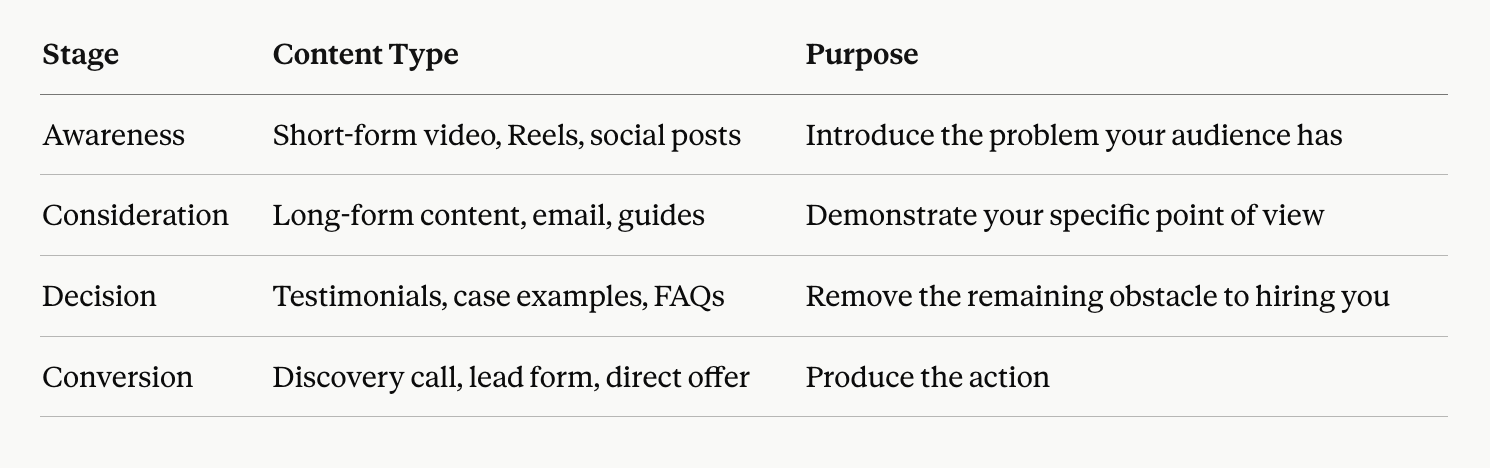
When all four stages consistently pull from the same core message, a prospect who sees even two or three pieces of your content begins building a clear picture of what you stand for. That clarity drives inbound inquiries. Posting frequency, production quality, and platform algorithms are all secondary to it.
This is what Antonelli's KickCharge methodology produces for home service brands, what Reber's Contractor Fight produces for trades businesses, and what Millennium's content system produces for a dance studio. In each case, content volume matters far less than message consistency.
Common Mistakes When Building a Content Funnel Without This Foundation
Choosing a niche that is still too broad. "Small business owners" is not a niche. "Independent attorneys who want to attract corporate clients but feel invisible online" is a niche. The narrower the message, the more clearly the right people recognize themselves in it.
Rotating your message before it lands. Most business owners abandon a core message after 60 to 90 days because they don't see immediate returns. Brand messages require consistent repetition over time before they produce compound results. Changing direction too soon means starting the trust-building process over from zero every quarter.
Confusing content volume with content strategy. Posting every day without a core message produces engagement data, not client revenue. The goal of a content funnel is not follower growth — it is moving qualified people from awareness to a conversation.
Writing for everyone. If your content tries to appeal to every possible prospect, it will not compel any specific one. The goal is not maximum reach. It is specific resonance with the audience most likely to hire you.
Describing your services instead of defending a position. Listing what you offer tells an audience what you do. Taking a position tells them what you stand for. Audiences make hiring decisions based on trust and alignment, not service menus. As Sinek famously established in his frameworks on organizational leadership, people buy why you do it — not what you do.
Need Help With Your Brand Messaging and Strategy Development?
If you worked through the exercise above and the answers are not coming clearly — or you have the answers but don't know how to turn them into a functional content system — we'd love to help! Book a free discovery call today and we'll go over your branding needs together.
FAQ
What is a core brand message? A core brand message is a singular, specific point of view that defines who your business serves, what problem it solves, and why its approach is different from competitors in the same category. Depending on the framework, it has also been called a brand mantra (Keller), a Zag (Neumeier), a BrandScript (Miller), and CoreBrand positioning (Gregory). The concept is identical across all of them: one clear, defensible position that every piece of content is built around.
Why isn't my content funnel converting followers into clients? The most common cause is the absence of a consistent, specific brand message. If your content does not communicate a clear point of view, your audience has no reason to move from passive follower to active prospect. Reach and conversion are separate problems. Inconsistent or generic messaging is almost always a conversion problem, not a reach problem.
How is a core brand message different from a tagline or mission statement? A tagline is a short, memorable phrase often used in advertising. A mission statement describes what an organization does and why it exists. A core brand message is the operational foundation beneath both — it is the specific position your business takes that informs every piece of content, every client interaction, and every marketing decision. The tagline may express it. The mission statement may reference it. Neither one replaces it.
How is a core brand message different from a niche? Your niche defines who you serve. Your core brand message defines the specific position you take for that audience. A financial advisor who works with physicians has a niche. A financial advisor who works with physicians and publicly argues that most high-earning doctors are financially exposed because no one teaches irregular income management — that is a core brand message applied to a niche.
Do I need a core brand message before I build a content funnel? Yes. Building a content funnel without one is building a pipeline that leads nowhere. The message determines what the funnel attracts, who it is designed for, and what action it is built to produce. Funnel structure is secondary to message clarity.
Can my core brand message change over time? The specific language may sharpen as you learn more about your audience. The underlying position — the values, the perspective, the problem you have chosen to solve — should stay stable. Businesses that frequently reposition confuse their audience and reset whatever trust-building progress they have made.
How long does it take before a core brand message produces results? There is no reliable universal timeline to cite here. What is consistently observed across the frameworks covered in this article is that message consistency over time is the variable that separates brands that compound from brands that plateau. Businesses that stay consistent with a clear message over six to twelve months typically report a shift in the quality of inbound inquiries — fewer price shoppers, more pre-qualified prospects who already understand what they are getting.

