
Virtual Receptionist for Roofing Companies: 4 Ways Roofing Companies Handle Inbound Calls — And What Each Actually Costs
If you run a roofing company, every inbound call matters.
That is especially true when you are paying for Google Ads, Local Services Ads, SEO, or lead vendors. A lot of roofers think they need more leads. In reality, many of them need a better system for handling the leads they already paid for.
I learned this the hard way.
When I worked with real estate clients, I tested some of the “famous” answering services that dominate Google search. On paper, they looked like the obvious solution. In practice, setup took a couple of weeks, and even after onboarding, it felt like a different receptionist answered every call. Each person was pulling up the script and learning it on the fly. That meant inconsistent conversations, awkward handoffs, and too many moments where the caller could tell this was not someone who really knew the business.
That experience shaped how I look at the four main ways companies handle inbound calls.
1. Answering service
This is usually the first thing a business tries when missed calls become a problem.
It sounds simple: hire a service, forward the phones, stop losing leads. And to be fair, it is better than voicemail. But in my experience, this is the weakest option on the list.
The biggest issue is consistency. With larger answering services, you are often not getting someone who truly knows your business. You are getting a rotating team working from a script. That can be fine for taking a basic message. It is a poor fit when the caller needs confidence, urgency, or a real conversation that reflects how your company actually operates.
The cost is also not always as cheap as it first appears.
Ruby’s public pricing starts at $250 per month for 50 receptionist minutes and goes up to $1,725 for 500 minutes.
Smith.ai’s live receptionist plans start at $300 per month for 30 calls and $810 per month for 90 calls before overages.
AnswerFirst starts at $30 per month plus $1.55 to $1.90 per minute, which can look inexpensive until call time starts stacking up.
So yes, answering services can plug a hole. But I do not personally recommend them as the long-term answer for a roofing company that cares about lead quality and customer experience.
If you want live human help, I would rather see you hire a dedicated receptionist.
2. U.S.-based receptionist
This is the most traditional live-person option.
A U.S.-based receptionist can learn your service area, understand your process, and sound more connected to your business because they are your person, not a random operator picking up from a shared call pool.
That is the real advantage here: consistency and familiarity.
The downside is cost.
According to the Bureau of Labor Statistics, the median hourly wage for receptionists was $17.90 in May 2024. Annualized over 2,080 hours, that comes to about $37,232 in base pay. The SBA says the true cost of an employee is typically 1.25x to 1.4x salary, which puts a full-time receptionist closer to about $46,540 to $52,125 per year in actual cost.
That may be worth it for some roofing companies. But for many, it is more than they want to spend just to make sure inbound calls are handled well.
And even then, you are still dealing with a human system. People get sick. People quit. People need training. People need management.
That is why the next option exists.
3. Outsourced VA or virtual receptionist
This is where a lot of businesses land when they want live help without full U.S. payroll.
Instead of hiring locally, you hire a dedicated remote assistant or receptionist. That gives you one person who can learn your scripts, your service areas, your estimate process, and your expectations.
Budget-wise, this is far more appealing for many contractors. OnlineJobs says entry-level Filipino VAs typically run about $400 to $600 per month, while mid-level talent often falls around $700 to $1,000 per month. Somewhere says full-time virtual administrative assistants from the Philippines often run around $800 to $1,000 per month, and its LATAM hiring page says remote talent can start as low as $12,000 per year, or about $1,000 per month.
If you need live support, this is the category I would look at before answering services. It gives you a dedicated human, lower cost, and a better chance at real business familiarity.
The tradeoff is that it is still human-dependent. You still have to hire well. You still have to manage. You still have to train. You still have to deal with turnover risk.
Which leads to the fourth option.
4. AI receptionist
This is the option that stands out once you stop thinking only in terms of “who will answer the phone” and start thinking in terms of consistency, speed, and cost.
An AI receptionist does not quit. It does not get sick. It does not get upset when you correct it. It does not need weeks of onboarding just to stop sounding new. And it does not depend on one person remembering your script on a busy day.
In your positioning, this option sits at about $400 per month and leads with a free demo.
That is what makes it so compelling.
It is dramatically cheaper than a full-time U.S. receptionist. It can be in the same general budget range as an outsourced VA. And it avoids one of the biggest problems with both answering services and live staff: inconsistency.
For roofing companies, that matters more than people realize.
Calls come in while crews are on roofs, while managers are driving, and after hours when nobody is in the office. If you are paying for inbound demand, your biggest risk is not just missing a call. It is losing the lead because the first response was slow, weak, or generic.
That is why this option becomes the obvious one.
If you want a live person, choose between a U.S.-based receptionist and an outsourced VA based on budget. But if you want consistency without the cost and management burden of a human hire, AI is the stronger answer.
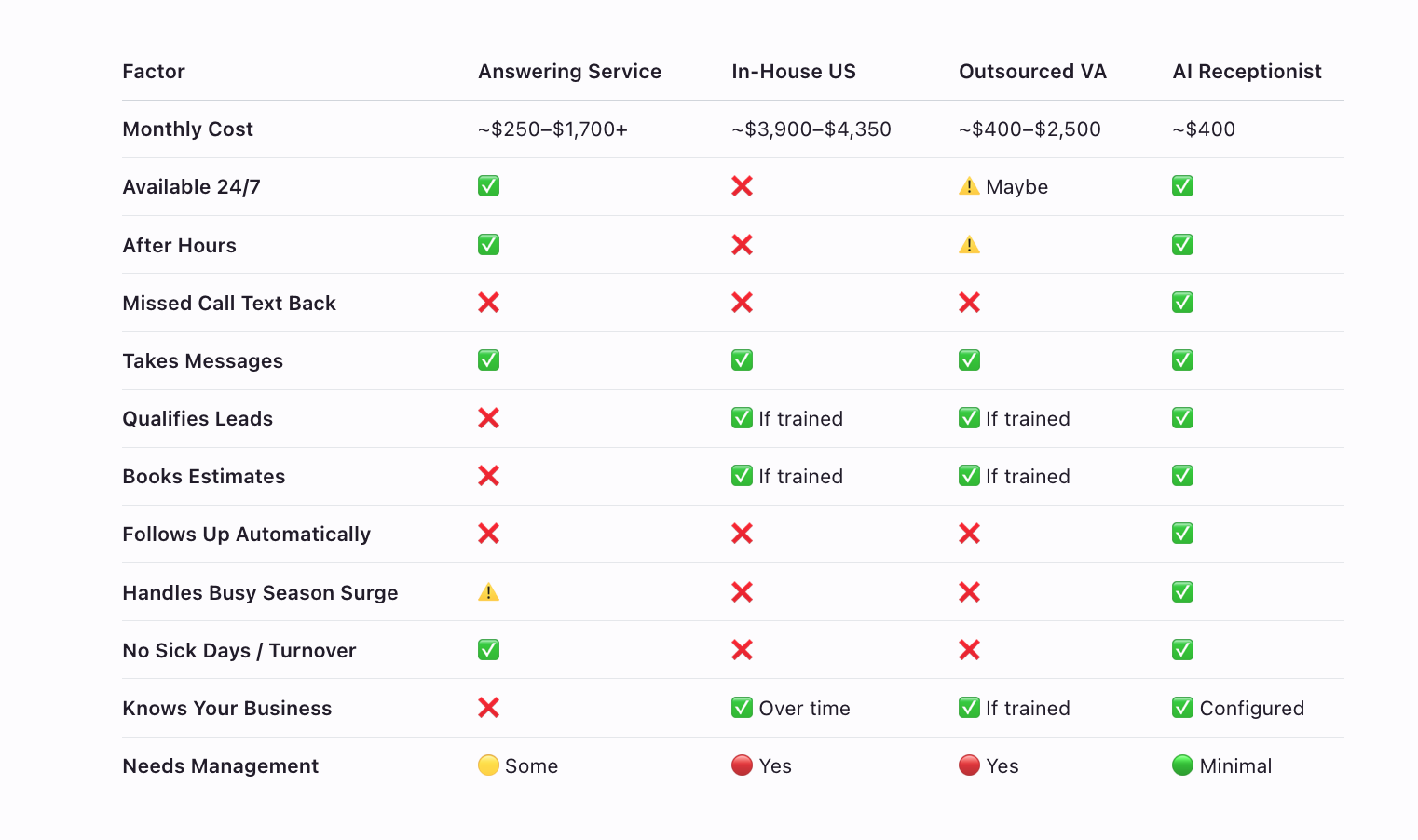
How to find a virtual receptionist for roofing business
If you are searching how to find a virtual receptionist for roofing business, the decision usually gets clearer when you ask the right question.
Do not ask:
Who can answer our calls?
Ask:
Who can handle our calls consistently?
Who can protect the money we spend on lead generation?
Who can respond without needing constant retraining?
Who can support the business without adding full-time payroll overhead?
That is why the order matters.
Most businesses first try answering services.
Then they realize they want someone more dedicated.
Then they compare U.S.-based staff with outsourced help.
Then they discover there is another option that gives them consistency without the same staffing problems.
That final step is where AI wins.
Final takeaway
Roofing companies usually move through these four options in order.
They start with an answering service because it seems easy.
They consider a U.S.-based receptionist because they want better quality.
They look at outsourced VAs because they want lower cost.
And then they realize AI gives them the consistency they wanted in the first place without the same payroll, turnover, and management headaches.
Whether you've already tried answering services, outsourced VAs, or in-house staff — or you just want to skip straight to what actually works:
AI Workforce is a Revenue Recovery & Lead Triage system built for high-ticket home service businesses. It captures, qualifies, and books — 24/7, 365 days. No sick days. No time off.
Book Your Free Live Demo
See how it would work inside your roofing company's actual call flow and booking process.
